
The Critical Role of Cooling in Heavy-Duty Performance
The health and efficiency of heavy-duty service vehicles rely critically on their coolant systems. In industries such as construction and specialized service, where durability is paramount, the cooling system plays a vital role in preventing engine overheating and ensuring optimal performance.
Maintaining the proper operating temperature is essential, as an estimated 40% of downtime (information from conversation history, needs careful phrasing as it’s not explicitly in the new sources, so I’ll omit the percentage and stick to source material for safety) is often attributed to cooling system issues. Understanding the function and maintenance of the core components—the radiator, water pump, and thermostat—is key to preventing costly repairs and maximizing vehicle lifespan.
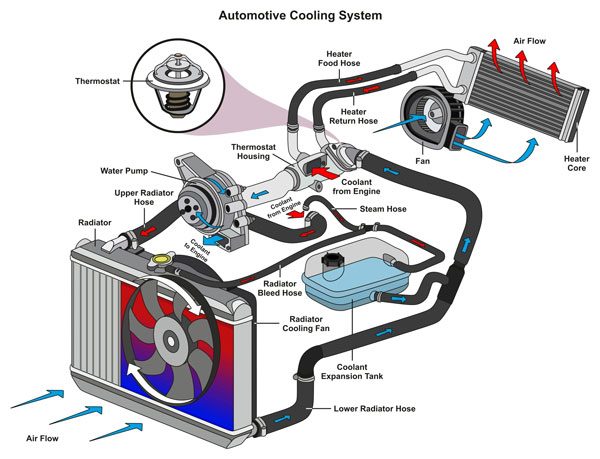
The Radiator: The Core Heat Dissipator
The radiator is the central component of any cooling system. Its primary function is to dissipate the heat absorbed by the coolant flowing through the engine block. Hot coolant flows into the radiator, where air passing through its fins facilitates the cooling process.
Enhancing Airflow
To maximize the system’s effectiveness, especially under heavy loads or in high-temperature conditions, the radiator is often surrounded by a fan shroud. The fan shroud directs the flow of air, ensuring it moves efficiently through the radiator’s surface area.
Maintenance and Contamination
Regular maintenance is crucial because the accumulation of dirt, grease, insects, leaves, oil, and other debris on the radiator’s surface significantly reduces the airflow and heat transfer.
- Cleaning Process: For cleaning the radiator, using compressed air is the preferred method for removing loose debris. When using compressed air, the nozzle should be held about 6 mm (0.25 inches) from the fins. The air must be directed parallel to the tube bundle to remove debris caught between the tubes. If the core is dried using compressed air, the air should be directed in the reverse direction of normal flow.
- Deep Cleaning: When replacing major components like the water pump, thoroughly cleaning the entire system—including the radiator core, engine block, and heat exchanger—is recommended to eliminate any sediment or particles that could reduce engine performance or cause serious failure.
Don’t forget, we also offer a wide range of spare parts for heavy machinery, so feel free to inquire about any replacement needs you may have. Just click on contact us.
The Water Pump: Driving Circulation
The water pump is a vital component responsible for the continuous circulation of coolant throughout the engine and back to the radiator. This constant movement facilitates consistent heat exchange.
Function and Drive Mechanism
In many heavy-duty engines, the water pump is driven by the serpentine belt. The serpentine belt is integral to the coolant system as it powers the water pump, fan clutch, and sometimes the oil and transmission coolers. If the serpentine belt is worn or snaps, it can lead to immediate coolant system failure and engine overheating.
Risks of Water Pump Failure
An ineffective water pump would cause the coolant to stagnate, resulting in rapid increases in engine temperature and potential engine damage. Coolant leakage should be checked visually. Excessive coolant leakage may indicate the need to replace the water pump seal or the entire pump. Failure of the water pump can result in severe engine overheating, which may cause cracks in the cylinder head or piston seizure.
When a new water pump is installed, the mechanic should inspect the hoses and the water thermostat as well, as this offers a good opportunity for replacement if necessary.
The Thermostat: Temperature Regulator
The water thermostat plays a critical role by regulating the engine coolant temperature. Thermostats are necessary for the proper functioning of the system.
Operation Principle
- Cold Operation: When the engine is cold, the thermostat restricts the coolant flow toward the radiator, utilizing an internal bypass duct. This allows the coolant to circulate only through the engine block and cylinder head to warm up quickly.
- Hot Operation: As the coolant temperature rises above the correct minimum operating temperature, the thermostat opens progressively. This opening allows more coolant to circulate through the radiator to dissipate excess heat.
Critical Warning
It is imperative NEVER to operate an engine without a thermostat installed in the cooling system. Removing the thermostat can lead to cooling system problems because thermostats help maintain the engine coolant at the appropriate operating temperature.
Coolant and System Integrity
Maintaining system integrity goes beyond the main components and requires attention to the fluids and connections.
Coolant Fluid (Refrigerant)
The coolant is vital for the system, as it prevents freezing of parts, prevents corrosion, and stops the formation of deposits. Coolant generally consists of three elements: water, glycol, and additives.
- Water Quality: Distilled or deionized water is recommended for engine cooling systems. Hard water, softened water, salt-conditioned water, and seawater should not be used.
- Glycol: Glycol helps protect against freezing and water pump cavitation. Perkins recommends a 1:1 mixture of water and glycol for optimal heavy-duty performance.
- Additives (SCA/ELC): Additives protect the metal surfaces of the cooling system. Perkins offers an Extended Life Coolant (ELC) which uses organic corrosion inhibitors and anti-foaming agents. Never mix ELC with conventional coolant, as this reduces the effectiveness and lifespan of the ELC.
Hoses and Clamps
Coolant hoses connect all these components, carrying coolant between the engine and the radiator. These hoses are made of flexible compounds (like silicone rubber) designed to handle high pressure, high temperatures, and engine vibrations.
- Types: Hoses include radiator hoses (upper and lower, connecting the engine and radiator) and heater hoses (carrying hot coolant to the heater core for cabin warmth).
- Material Choice: Reinforced rubber hoses are suitable for heavy-duty vehicles, high-pressure systems, and industrial applications due to their durability and strength.
- Inspection: Regular visual inspection is crucial. Hoses can become brittle, swollen, or cracked over time, leading to leaks or reduced efficiency. Swelling typically indicates internal deterioration, possibly due to electrochemical degradation or exposure to contaminants. Clamps must be tight and free of rust to prevent coolant leaks and ensure the hose functions correctly. Hoses should feel firm but not too rigid or too soft; if they feel very soft or hard and brittle, they require replacement.
Preventing Downtime and Damage
The combined action of the water pump (circulation), the radiator (heat exchange), and the thermostat (temperature regulation) ensures the long life and economy of heavy machinery.
Preventive maintenance is essential, as incorrect maintenance procedures, such as extending maintenance intervals or failing to use recommended fluids, can reduce engine life. Regular inspections of hoses for cracks and loose clamps are necessary. Furthermore, failure to clean the system properly can lead to accelerated component wear and reduced service life. Always refer to the manufacturer’s manual to determine the most suitable coolant and service intervals.