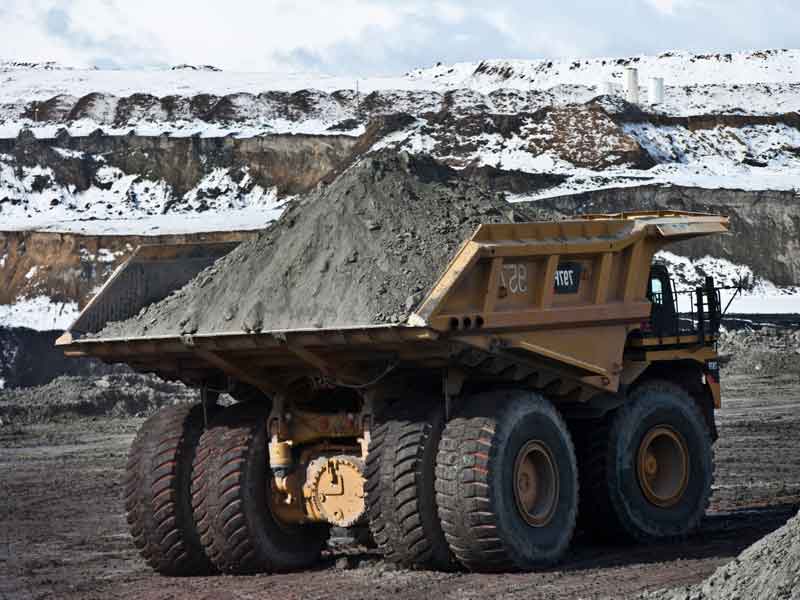
In the world of heavy machinery, there are giants. And then, there is the Caterpillar 797F. This isn’t just a truck; it’s an ultra-class haul truck, an engineering marvel designed for a singular purpose: to move mountains of material at the lowest possible cost per ton.
Today, we’re doing a deep dive on this Caterpillar colossus.
The Evolution of a Giant: A Brief History of the 797 Series
The Caterpillar 797 lineup was born in 1998 with a clear goal: to push the boundaries of payload capacity.
- The Origin (Cat 797): Launched in 1998, this was the first mining truck of its kind to break the 360-short-ton (327-tonne) payload barrier.
- The Upgrade (Cat 797B): Introduced in 2002, this model increased the horsepower and payload, solidifying the 797’s design.
- The Perfection (Cat 797F): The star of our article. Launched in 2008 and entering full production in 2009, the 797F replaced the 797B. Its most significant upgrade was the new Cat C175-20 engine, a more efficient and powerful V20 designed to meet Tier 2 (and later Tier 4) emissions standards.
The 797F wasn’t just an update; it was a re-engineering focused on fuel efficiency and reliability—the two most critical factors in a 24/7 mining operation.
Caterpillar 797F Tech Specs: The Numbers Behind the Power
To understand why the 797F is an industry icon, its specifications tell the whole story. Notably, this haul truck is the world’s largest mechanical-drive mining truck.
- Nominal Payload Capacity: 400 short tons (363 metric tonnes)
- Gross Machine Weight (GMW): 1,375,000 lbs (623,690 kg). That’s over 600 metric tonnes when fully loaded.
- Engine: Cat® C175-20, 20-Cylinder Quad-Turbocharged Diesel
- Gross Power: 4,000 HP (2,983 kW)
- Top Speed (Loaded): 42.3 mph (68 km/h). This speed is astonishing for a machine of its size.
- Transmission: 7-speed planetary power-shift (mechanical drive)
- Tires: 59/80R63. These tires are an engineering feat in themselves. Developed by Michelin or Bridgestone, they stand over 13 feet (4 meters) tall.
Where Does the Cat 797F Work? The Titan’s Habitat
You won’t find a 797F on a local construction project. These goliaths are reserved exclusively for the world’s largest and most productive open-pit mining operations.
Their design is optimized for 24/7/365 operations, moving massive volumes of overburden (waste rock) and ore.
The primary locations where you’ll find the 797F hard at work include:
- Copper Mines: Especially in the massive mines of Chile (like Escondida) and the United States (Arizona, Utah).
- Oil Sands: They are a critical component in the Athabasca oil sands region of Canada (Fort McMurray, Alberta).
- Iron Ore: In the vast operations of the Pilbara region in Western Australia.
- Coal Mines: In large surface mines across Australia and the USA.
The 797F is built to withstand extreme climates, from the scorching heat of the Australian outback to the sub-zero temperatures of the Canadian winter.
Don’t forget, we also offer a wide range of spare parts for heavy machinery, so feel free to inquire about any replacement needs you may have. Just click on contact us.
Anecdotes and Curiosities: Secrets of the 797F
Beyond its spec sheet, the 797F is surrounded by facts and stories that border on the unbelievable.
1. “Some Assembly Required”
A Caterpillar 797F is far too large to be transported on any road or railway in one piece.
It is shipped in “kit” form to the mine site, requiring between 12 and 16 semi-trucks to haul all its components (the frame, the dump body, the axles, the engine, etc.). A specialized crew then spends weeks assembling the truck directly on-site.
2. “Expensive Shoes”
The most frequently cited fact about the 797F is the cost of its tires. Each 59/80R63 tire can cost upwards of $50,000 USD (and often much more, depending on supply contracts). The truck uses six of them. That means the tires alone can be worth more than a luxury sports car.
3. The Rivalry: Mechanical vs. Electric
The Cat 797F holds a key distinction: its mechanical-drive transmission.
Most of its direct competitors, like the Komatsu 980E-5 or the Liebherr T 284, use a diesel-electric drive (where the diesel engine acts as a generator for electric motors at the wheels). Caterpillar, however, bets on the raw power and proven reliability of a direct mechanical transmission.
This makes it a favorite for many operators who prefer the “direct feel” and superior performance of a mechanical drive, especially when handling steep grades.
4. Is It the Biggest?
In the battle for “world’s largest mining truck,” the 797F is always in the conversation. Currently, the BelAZ 75710 (from Belarus) holds the world record for payload capacity (450 metric tonnes). However, the BelAZ uses a radically different, eight-tire, dual-engine design.
For most mining purists and operators, the Caterpillar 797F remains the undisputed king of conventional-design haul trucks (rigid frame, six tires).
Why the 797F Remains King?
The Caterpillar 797F is more than just a machine; it’s a productivity symbol. Its success isn’t just measured in horsepower or size, but in reliability, uptime, and a low operating cost per ton.
For a mining company, every cent saved on fuel, maintenance, and every second the truck is operational translates into millions of dollars. The 797F, with its robust C175-20 engine and legendary mechanical transmission, is built to do one thing: work.
It is an engineering titan that, decades after its lineage began, continues to be the benchmark against which all other ultra-class trucks are measured.