Whether you are walking through a bustling city center or passing by a massive industrial job site, construction cranes are an unmistakable hallmark of modern development. These giant machines perform the heavy lifting that makes skyscrapers, bridges, and complex infrastructure projects possible.
Choosing the right crane is crucial for project safety, efficiency, and budget management. In this guide, we break down what construction cranes are, how they function, and the primary types used across the construction industry today.
What Is a Construction Crane?
A construction crane is a piece of heavy machinery equipped with cables, wire ropes, sheaves, and a hoist mechanism designed to lift, lower, and move heavy materials horizontally and vertically.
Cranes rely on fundamental principles of physics—primarily leverage, counterweights, and mechanical advantage—to lift loads that far exceed the capacity of standard machinery.
Core Components of a Standard Crane:
- Jib (Boom): The long horizontal or angled arm that extends out to support the load.
- Hoist: The mechanical device that raises and lowers the load via wire cables.
- Counterweights: Heavy weights placed at the rear of the crane to offset the front load and prevent tipping.
- Cab: the control center where the crane operator sits to maneuver the machine.
- Outriggers/Tracks: Stabilization mechanisms that distribute weight evenly across the ground.
The Two Main Categories: Static vs. Mobile Cranes
Before diving into specific models, construction cranes are broadly divided into two major structural categories:
- Static Cranes: Fixed structures assembled on-site for long-term projects. They offer unmatched height and lifting capacity but remain in a single location throughout construction.
- Mobile Cranes: Mounted on trucks, crawlers, or rubber tires. They can be driven to job sites, set up quickly, and relocated easily across different project areas.
5 Major Types of Construction Cranes
1. Tower Cranes (Static)
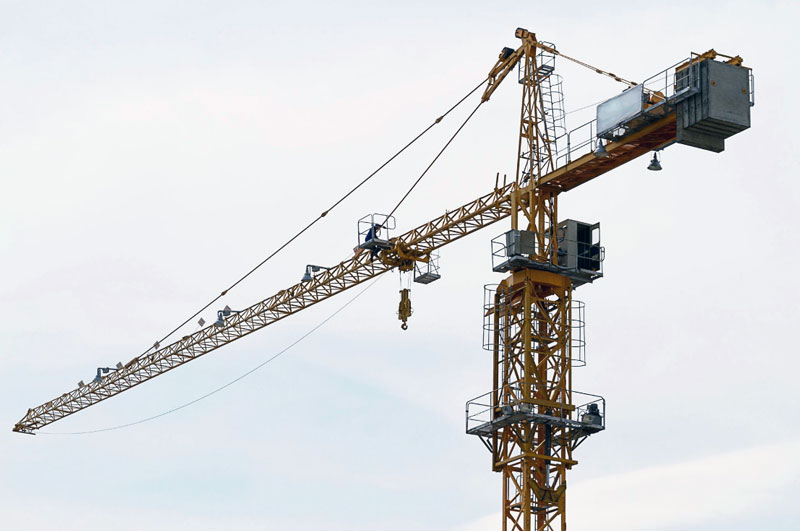
Tower cranes are the workhorses of urban skyline construction. Fixed to a concrete slab on the ground (and sometimes attached to the sides of buildings as they rise), tower cranes offer extraordinary reach and height capacity.
- Best For: High-rise residential buildings, skyscrapers, and long-term commercial projects.
- Key Advantage: Exceptional height and high lifting capacity in tight urban footprints.
- Limitation: Requires complex assembly, disassembly, and significant installation time.
2. Mobile Telescopic Cranes (Mobile)
Equipped with a hydraulic cylinder that extends and retracts like a telescope, telescopic cranes are mounted on wheeled chassis. They are highly adaptable and ready for quick deployment.
- Best For: Short-term lifting tasks, emergency repairs, and multi-site operations.
- Key Advantage: Fast setup time and high road mobility between job sites.
- Limitation: Lower maximum load capacity compared to lattice-boom or large crawler cranes.
3. Crawler Cranes (Mobile)
Instead of rubber wheels, crawler cranes operate on a track system (similar to a tank). This distributes weight over a large surface area, allowing them to travel across soft, unpaved terrain while carrying heavy loads.
- Best For: Large-scale infrastructure projects, wind farm construction, and soft ground conditions.
- Key Advantage: Superior stability on uneven ground; able to “pick and carry” (move while holding a load).
- Limitation: Heavy transport costs; requires specialized trailers to move from site to site.
Don’t forget, we also offer a wide range of spare parts for heavy machinery, so feel free to inquire about any replacement needs you may have. Just click on contact us.
4. Rough Terrain Cranes (Mobile)
Designed specifically for off-road construction sites, rough terrain cranes feature four wide rubber tires, four-wheel drive, and high ground clearance. They use outriggers to stabilize the crane during operations.
- Best For: Unpaved construction sites, mining operations, and remote infrastructure projects.
- Key Advantage: Excellent maneuverability on mud, gravel, and steep grades.
- Limitation: Not street-legal; must be hauled to job sites via flatbed trailers.
5. Overhead Cranes (Bridge Cranes) (Static / Industrial)
Typically installed inside industrial buildings or shipyard facilities, overhead cranes consist of parallel runways with a traveling bridge spanning the gap. A hoist moves along the bridge to lift material within a fixed 3D grid.
- Best For: Manufacturing plants, steel mills, shipping yards, and equipment maintenance bays.
- Key Advantage: Maximizes indoor floor space while providing high precision movement.
- Limitation: Restricted entirely to the track footprint where it is installed.
Comparison Summary: Which Crane Fits Your Needs?
| Crane Type | Primary Environment | Mobility | Max Weight Capacity | Key Strength |
| Tower Crane | High-Rise Urban Sites | Fixed / Static | Very High (up to 20+ tons) | Unmatched height & reach |
| Mobile Telescopic | Highways, Short Projects | High (Street-legal) | Moderate to High | Fast setup & flexibility |
| Crawler Crane | Heavy Civil / Wind Farms | Low (Tracks) | Extremely High (up to 3,000+ tons) | Moves while loaded |
| Rough Terrain | Remote / Off-road | Medium (Site-only) | Moderate | All-terrain capability |
| Overhead Crane | Indoor Industrial | Fixed Structure | Moderate to High | Space-efficient indoor lifting |
How to Choose the Right Crane for Your Project
To select the optimal crane for your construction job, evaluate these five critical factors:
- Load Capacity & Reach: Calculate both the maximum weight to be lifted and the maximum distance (radius) from the crane’s center point.
- Ground & Site Conditions: Determine if the surface is concrete, gravel, or soft soil. Soft terrain favors crawlers or rough-terrain setups.
- Site Access & Clearance: Measure overhead power lines, surrounding buildings, and road access for transport vehicles.
- Project Duration: Long-term projects justify the assembly cost of tower cranes, whereas short tasks benefit from mobile telescopic units.
- Budget & Labor: Factor in transport costs, mobilization fees, and required certified operator costs.
Key Takeaways
Understanding the specific features and strengths of each construction crane ensures smoother site operations, prevents costly downtime, and maintains safety compliance. From the towering heights of static tower cranes to the rugged adaptability of crawler and mobile cranes, every model serves a distinct engineering purpose.